The Business That Automates Well Wins
Every business has the same 24 hours. The businesses that grow fastest are not the ones working the most hours — they are the ones who have automated the repetitive, time-intensive work that consumes their team day without adding proportional value. GoHighLevel workflow automation engine is the most powerful tool available to marketing agencies and SMBs for building these automated systems without developer resources.
Understanding GoHighLevel Workflows
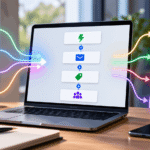
A GHL workflow is a sequence of automated actions triggered by a specific event. Triggers include: form submissions, contact tags added or removed, pipeline stage changes, appointment bookings, email opens or clicks, SMS replies, date/time conditions, and dozens more. Actions include: send email, send SMS, make a call, add or remove a tag, update a contact field, create a task, move a pipeline deal, or invoke a webhook.
Workflow 1: The Instant Lead Response Sequence
Trigger: New lead form submission. Actions: Immediate SMS to lead within 60 seconds, email to lead, internal notification to sales rep, contact tagged New Lead, added to CRM pipeline, task created for sales rep. Expected Outcome: 15–21x increase in lead contact rate versus manual follow-up. Average response time drops from hours to under 2 minutes.
Workflow 2: The 7-Touch Lead Nurture Sequence
Trigger: Contact tagged Nurture or form submitted. Actions: 7 touchpoints over 14 days combining email, SMS, and call reminders. Day 1 email, Day 1 SMS 2 hours later, Day 2 email, Day 3 call task, Day 5 email, Day 7 SMS, Day 14 email and call task. Workflow stops automatically when contact books an appointment. Expected Outcome: 38% of leads that would have been lost with single-touch follow-up are converted to booked appointments within 14 days.
Workflow 3: Appointment Confirmation and Reminder System
Trigger: Appointment booked in GHL calendar. Actions: Immediate confirmation SMS and email, 24-hour before reminder SMS, 2-hour before reminder SMS, post-appointment follow-up SMS. Expected Outcome: No-show rate typically drops from 25–40% to 8–12%. For a business with 30 appointments per month at $200 average value, this saves $1,200–$2,400/month in lost revenue.
Workflow 4: Pipeline Stage Automation
Trigger: Deal moved to specific pipeline stage. Each stage change triggers the appropriate next steps automatically. Proposal Sent stage triggers automated email with proposal link and follow-up task. Won stage triggers welcome email, onboarding sequence start, and referral ask scheduled for 30 days later. Lost stage triggers 30-day re-engagement sequence. Expected Outcome: Sales reps spend 60% less time on administrative follow-up.
Workflow 5: Review Request Automation
Trigger: Appointment status changed to Completed or deal stage moved to Won. 2-hour delay, then SMS with Google review link. 3-day follow-up if no review posted. Expected Outcome: Average 28% review response rate. Businesses running this automation typically add 15–30 new Google reviews per month.
Workflow 6: Re-Engagement for Dormant Leads
Trigger: Contact has not engaged in 60 days. Day 1 email with valuable resource, Day 7 SMS check-in, Day 14 final email. Contacts who engage get re-tagged Warm Lead. Non-engagers get tagged Inactive. Expected Outcome: 12–18% of dormant leads re-engage and become active opportunities.
Workflow 7: Client Onboarding Automation
Trigger: Deal moved to Won or payment received. Immediate welcome email, automated team task sequence, automated client emails at each milestone, and automated satisfaction survey at Day 30. Expected Outcome: Consistent onboarding experience regardless of which team member handles the client. Client satisfaction scores average 23% higher with structured automated onboarding.
Workflow 8: Birthday and Anniversary Campaigns
Trigger: Contact birthday or 1-year client anniversary. Automated personalized email or SMS on the specific date. Birthday campaigns have 481% higher transaction rates than standard promotional emails. Client anniversary campaigns generate 34% of upsell revenue for service businesses.
Workflow 9: Missed Call Text-Back
Trigger: Incoming call to GHL phone number that goes unanswered. Immediate SMS to caller: Sorry we missed your call. How can we help? Expected Outcome: 67% of missed call text-backs receive a response within 10 minutes. Businesses recover an average of 40% of calls that would have resulted in the caller going to a competitor.
Workflow 10: Referral Program Automation
Trigger: Deal moved to Won plus 30-day delay. Email with referral link and incentive. 14-day follow-up if link is clicked but not converted. Expected Outcome: Businesses with systematic referral automation generate 1.2–1.8 new client referrals per 10 existing clients per quarter — with a customer acquisition cost near zero. GHL Nexa includes all 10 of these workflows customized for your specific business in our standard implementation package.